Camping Activities in England: Ideas for Days, Evenings and Rainy Weather
You do not need to fill every hour of a camping trip. Pick one outing you would like to try, a few easy things to do on site and an alternative for when the weather or your energy changes. Leave room for people to join in, sit out or suggest something else.
These are practical options for a trip in England, rather than a ranking. Use the weather, your group’s interests and the activities permitted where you are staying to choose what fits.
In a nutshell
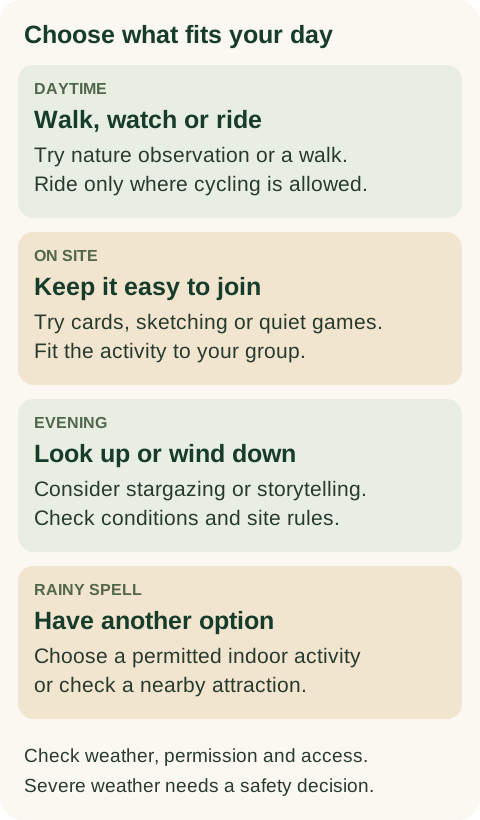
Consider a walk or nature observation during the day, a ride on a route where cycling is permitted, and quiet games or sketching back at camp. Keep cooking optional and outdoors where allowed. For the evening, try storytelling or plan a little stargazing. Have an indoor alternative, and treat severe weather as a safety decision rather than a reason to squeeze more activities into the tent.
1Walking and watching nature
Choose a walk with something your group wants to notice: trees, birds, changing colours or a view. You could make a short observation list, take photographs or pause to sketch. A list of things to spot is an option; there is no need to collect them or turn the outing into a competition.
Follow local signs, use marked paths unless wider access is permitted, and leave wildlife and its habitat undisturbed. Choose an activity that fits the access available at that place.
For children, you might choose just a few things to look for and let them help choose the next pause. Adults could try sketching the same view or taking photographs around a theme. For a quieter option, consider observing from a place you have checked is suitable for sitting. Choose the length, terrain and stopping points with the people taking part, rather than assuming everyone wants a long walk.
2Cycling, if the route fits
Before planning a ride, check that cycling is permitted along the whole route. A public footpath is not automatically a cycle route. Check the route’s status, local restrictions, surface and suitability for everyone taking part.
Check the route’s status, current restrictions and conditions, then consider distance, surfaces, gradients and the group’s experience. You could choose a shorter ride, agree a stopping point or pick a different activity if the route does not suit someone. These are planning choices, not a recommendation for an unnamed route.
3Quiet games and things to do on site
Try a pack of cards, a drawing challenge, a short quiz or a story built one sentence at a time. For an observation game, make a checklist of things people can spot without entering neighbouring pitches or disturbing plants and wildlife. Let participants choose whether to keep score or simply compare what they noticed.
Adapt the game rather than insisting everyone plays it the same way. You might shorten a round, use spoken clues instead of written ones, let people work in pairs or choose an activity that can be done from a suitable seat. Ask what works for the people involved; no single version will meet every access need or interest.
Check the site’s rules before setting up a game, and choose a place and noise level that respect other campers. If you want a more active game, ask whether there is a designated space for it. For wider questions about facilities and the kind of site that fits your trip, see our guide to choosing a campsite.
4Make outdoor cooking optional
If cooking is part of the fun, consider making one simple meal together using equipment you already know how to use. People can choose a role they are comfortable with, including setting the table or deciding what to eat. Keep a no-cook option in mind if cooking is not permitted or the arrangements are unsuitable.
Check permission and current restrictions first. The Countryside Code says barbecues should be used only where signs say they are allowed. Home Office outdoor fire-safety guidance says not to use a barbecue indoors, in a tent, under an awning or in a caravan, and not to cook inside a tent.
Cheshire Fire and Rescue Service warns that fuel-burning devices used inside tents can cause carbon-monoxide poisoning. It says fuel-burning equipment should never be used inside a tent, camper or other enclosed shelter. Do not move a stove or barbecue into the tent when rain interrupts your plan.
Follow the equipment’s instructions and the site’s requirements. This activity guide does not replace an appliance’s operating instructions. For organising the preparation and washing-up side, use our family camping kitchen guide.
5Evening stories or a little stargazing
For a quiet evening, consider reading, cards or storytelling. Ask whether everyone wants a group activity or some time to themselves, and keep the site’s quiet-time rules in mind.
For stargazing, choose a clear evening and decide what to look for before you leave. A current night-sky guide can help you identify visible planets, constellations or seasonal events. Check the date and viewing conditions rather than expecting the same sky on every trip.
Check the forecast, the site’s arrangements for being outside after dark and whether the place you intend to use fits your group’s needs. You could plan a short look at the sky rather than a long session. Have another evening option if conditions are unsuitable; a calendar is not a promise that you will see its listed sights from your campsite.
6Rainy-day alternatives
For a wet spell when conditions remain suitable, consider reading, drawing, cards or planning the next outing in a permitted indoor space. Give people a choice of a shared activity or their own quiet time.
A nearby museum, gallery, visitor centre or other indoor attraction could be another option. Check its current opening times, booking arrangements, cost, transport and access information before relying on it. Ask about the details that matter to your group, such as the walking involved, places to sit or relevant facilities, rather than assuming an attraction’s general description answers everything.
Severe weather needs a different decision. The Met Office explains that warning colours combine potential impact and likelihood, so read the details of any warning. Its camping guidance advises people outdoors during a thunderstorm to seek shelter immediately, ideally in a permanent structure or otherwise a car. It says a tent, shed or place beneath a tree is not adequate shelter. Do not treat games in the tent as a thunderstorm plan.
7Choose a plan your group can change
Before settling on an activity, check:
- Does anyone want a shorter, quieter or seated option?
- Have you checked permission, access and current conditions for the actual place?
- Does the plan fit the group’s interests, energy and practical needs?
- Have you read the forecast and any weather warnings?
- For cooking, are the site arrangements and equipment instructions clear?
- For an attraction, have you checked opening, booking, cost and access details?
- What will you do instead if the first option no longer works?
Choose a small number of options rather than a packed timetable. A plan that lets someone take a break, change their mind or skip a round can leave more room for everyone to enjoy the trip in their own way.
Read next
How to Choose a Campsite You’ll Actually Enjoy
Compare campsite access, pitch size, facilities, rules, safety, accessibility, costs and booking terms—and know what to confirm before you pay.
How to Plan Your First Wild-Camping Trip in the UK
The appealing version of wild camping begins with an empty hillside and ends with breakfast beside a magnificent view.
Join the conversation
What has worked for you? Share a useful tip, ask a question or tell us about your experience. Keep it friendly and leave out personal contact details.
Comments are reviewed before appearing. Your display name and comment will be public; your email address will not. How we handle your information.