
Air Tent vs Pole Tent: Which Suits Your Camping Trip?
There comes a moment, usually in a car park with a trolley full of tent bag and a growing sense of dread, when every camper faces the same question: poles or air? It sounds like a small decision, right up until you’re the one trying to feed a bendy pole through a sleeve while the wind has opinions. This piece looks at what actually distinguishes air-beam tents from conventional pole tents, using two specific Outwell models as worked examples of the numbers involved. Nothing here is a verdict on which type is better, faster, lighter or more weatherproof as a class. Think of it instead as separating the genuinely useful distinctions from the marketing-shaped assumptions, so that whichever bag you end up wrestling out of the boot, you know roughly what you’re dealing with.
In a nutshell
The basic difference is what holds the fabric up: conventional tents use poles, while inflatable tents use air beams. That alone does not tell you which tent is lighter, quicker to pitch or better in bad weather. The two Outwell models below illustrate different complete designs; they are not a like-for-like test of every air tent against every pole tent.
1How the support systems differ
The core distinction is refreshingly simple once you strip away the sales copy. A pole tent uses a system of rigid poles to form the skeleton for the tent body and fly, while an inflatable tent swaps those poles for air beams, with the rigidity doing the same structural job in the same places a pole would normally sit. That’s it. It’s not a claim about which one shrugs off a gale better, weighs less in your boot, or goes up faster while you stand there holding a torch in your teeth. It’s simply a description of what’s providing the shape.
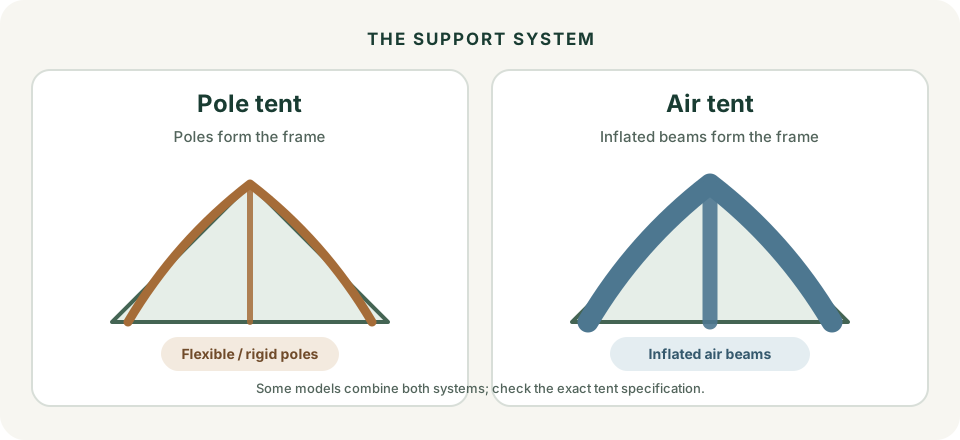
Where this gets interesting is in the exact hardware, because manufacturers don’t all reach for the same materials. Outwell’s Cloud 5 Plus, a two-room dome tent, is specified with 11 mm Duratec fibreglass poles. Its air-tent sibling, the Sacramento 4 Air, a four-room tunnel tent, uses what Outwell calls a Rigid Air System paired with a 16 mm aluminium pole, and specifies a maximum inflation pressure of 9 psi, or 0.6 bar. That last figure matters rather more than it sounds like it should, because over-inflating an air tent isn’t the kind of mistake you want to discover halfway through a bank holiday weekend. These are exact specifications for these exact models, not a general rule for every air tent on a campsite, so if you’re peering at a different tent entirely, its own instructions are the ones that count.
2Pitching and the kit you need
Practise pitching before the trip and follow the instructions for your tent. Some pole sleeves are much easier with two people, so check that your planned camping party can manage the job. Pack a suitable mallet where needed, align the guylines as instructed and leave room to adjust their tension.
Treat quoted pitching times as estimates, not a promise about your first attempt. Your experience, available help and the ground all matter. The Sacramento 4 Air’s listed kit includes a pump, pegs, repair kit, hooktrack hooks and valve tool; check the contents of the exact package you are buying.
3Weight, packed size and sleeping capacity
Numbers on a spec sheet are where good intentions go to be tested, so here are the ones that were actually verified for these two models. The Cloud 5 Plus is specified to sleep five, weighs 10.1 kg and packs down to 65 x 25 cm, with that 15-minute pitching time noted above. The Sacramento 4 Air is specified to sleep four, weighs 24.9 kg and packs down to 92 x 41 x 35 cm. Lay those figures side by side and the air tent is considerably heavier and bulkier in this particular pairing, despite sleeping one person fewer, which is a fair reminder that a support system alone doesn’t dictate what ends up on your back or in your boot.
What these figures can’t tell you is how they translate into a decision about your own trip. Nobody has established here how packed bulk should weigh against a weekend away versus a fortnight, nor how either tent’s pitched footprint fits into a particular patch of campsite, so no such conclusion is offered. Packed dimensions describe the bag on the shelf, not the shape the tent takes once it’s up and guyed out, and the two should never be treated as interchangeable when you’re eyeing up a pitch.
4Maintenance and spare parts
On an air tent, dirt around a valve can interfere with the seal. Check the valve using the cleaning and inspection procedure for that model before assuming the beam is punctured. Avoid tools or cleaners that could damage the sealing surfaces. If the leak continues, inspect the rest of the system as instructed or arrange help.
Treat an in-field air-tube repair as temporary unless the exact repair instructions say otherwise. A burst or badly damaged tube may need replacement. Check how to obtain the right part before relying on a repair kit to keep the trip going.
With a pole tent, distinguish a damaged pole section from worn or snapped shock cord. The cord helps keep sections together during assembly, while the sections provide the structure. Check the repair procedure and compatible parts for your pole set before attempting a replacement.
Keep a note of your tent’s model, production year and product number. These details help you identify compatible poles, tubes, valves and other spares, which can differ even between tents with similar names.
5Safety comes before tent type
Some things matter regardless of whether you’re sleeping inside an air beam or a pole. Chief among them: never use a fuel-burning stove, or any similar fuel-burning device, inside a tent. This isn’t a style preference or a footnote, it’s a rule backed independently by both the Camping and Caravanning Club and a UK fire and rescue service, which is about as close to consensus as camping advice gets. The Club puts the reasoning plainly, warning that using a stove inside a tent risks carbon monoxide poisoning as well as a heightened fire hazard, and fire authority guidance separately urges cooking outside, away from the tent and clear of flammable material, since fires in tents spread quickly and most only have the one exit. Treat that instruction as fixed, whatever the weather is doing outside.
Recheck pegs and guylines during the stay, especially after rain or a change in wind. Follow the tent’s pitching instructions and adjust tension without overstressing the fabric. If conditions become unsuitable, use your plan to move to a safer place or leave; a different support system does not make an exposed pitch safe.
6Checks to make before choosing
A short list, then, of things worth confirming before you commit to a particular tent rather than a particular type of tent. Check the exact model’s specified maximum inflation pressure if you’re considering an air design, since that figure is set by the manufacturer for that model and shouldn’t be guessed at or borrowed from a similar-looking tent. Check what’s actually included in the box, because contents vary between models, sometimes down to whether a pump is provided at all. Check the packed dimensions and weight against how you’ll actually be transporting the thing, bearing in mind that packed size is not the same question as how much room the tent takes up once it’s up and you’re living in it. Check the manufacturer’s own pitching instructions rather than assuming one system’s habits apply to another. And check spare-parts availability by model and year before you buy, rather than discovering the gap the day a pole snaps.
Choose between complete tent designs rather than expecting air or poles to win every comparison. Check weight, packed size, usable space, repair options and the work involved in pitching. The better choice is the one that fits your trip, transport and available help.
Read next
How to Choose a Sleeping Bag for UK Camping
Choose a sleeping bag suited to UK conditions, with clear advice on temperature ratings, insulation, fit and getting a comfortable night outdoors.
How to choose a sleeping mat for UK camping
A practical guide to warmth, comfort, construction, fit and reliability, from inexpensive foam mats to compact insulated air mats.
Join the conversation
What has worked for you? Share a useful tip, ask a question or tell us about your experience. Keep it friendly and leave out personal contact details.
Comments are reviewed before appearing. Your display name and comment will be public; your email address will not. How we handle your information.