GUIDES · CAMPING GEAR
How to Choose a Sleeping Bag for UK Camping
Stay warmer, sleep better and spend money on the things that actually improve your nights outside.
CampGear.uk · Independent outdoor guidance
Choosing a sleeping bag looks easy right up until you actually try to buy one.
You start with a perfectly reasonable requirement — I’d like to be warm when I go camping — and half an hour later you’re comparing comfort limits, fill powers, down ratios and packed weights, wondering whether saving 180 grams is really worth another £120.
It doesn’t need to be that complicated.
Most of the specifications fall into place once you stop asking “Which sleeping bag is best?” and ask a better question instead:
What does my sleeping bag actually need to do?
A bag for weekends on established campsites has a different job from one being carried through the Highlands for five days. Get the basic requirements right first, and the technical details become much easier to judge.
In a nutshell
- Choose a sleeping bag primarily by its comfort temperature, not its season label or extreme rating. Build in some margin below the temperatures you realistically expect — more so if you already know you sleep cold.
- Treat the bag and sleeping mat as one system. A warm bag cannot make up for inadequate insulation underneath you.
- After warmth, decide whether down or synthetic insulation suits the way you camp. Down earns its keep when weight and packed size matter; synthetic is often cheaper and more forgiving around damp. Weight, fit, shape and features come after that.
- In short: sort the warmth and the sleep system first, then pay for weight savings or specialist features only once you actually need them.
1Temperature ratings: what actually matters?
The familiar labels — summer, two-season, three-season, four-season — are useful shorthand, but they’re a fairly blunt instrument.
A British “summer” can mean a mild campsite evening in July, or a surprisingly cold night once you’ve gained some height. “Three-season” has the same problem: three seasons where, exactly?
For sleeping bags covered by the current ISO 23537 standard, standardised testing gives us something far more useful to compare. You’ll commonly see three figures:
Comfort is the important starting point for most buyers. It sits at the warmer end of the useful guidance — the point around which a standardised sleeper should still manage a relaxed night’s sleep.
Limit (sometimes called the lower or comfort limit) is colder. It relates to a sleeper curled up and starting to fight the cold. Useful information — but not the number to treat as your normal target for a comfortable night.
Extreme is an emergency figure. It belongs in the safety information, not in your shopping strategy.
So if a bag says Comfort 2°C / Limit -4°C, resist the urge to mentally file it away as “a minus-four bag.” For ordinary trip planning, the 2°C figure is the far more useful place to start.
Standardised testing gives us a common reference point. It does not, unfortunately, turn actual humans into standardised sleepers.
Understanding sleeping bag temperature ratings
The three figures, in short:
Temperature ratings are standardised references, not promises about how any one individual will actually feel. Comfort is your practical starting point; Limit is supporting information; Extreme is a safety figure and nothing more.
2How warm should your sleeping bag be?
This is where your own experience starts to matter more than the label on the bag.
Two people can use the identical sleeping bag on the identical night and file completely different reports the next morning. Whether you’ve eaten properly, how tired you are, what you’re wearing, your metabolism, the humidity, wind exposure and the rest of your sleep system can all change how warm you feel.
Which means choosing a bag whose comfort rating exactly matches the coldest temperature in the forecast leaves you almost no room for reality to intervene.
As a rough starting framework:
| Conditions you realistically expect | Sensible starting point |
|---|---|
| Mild summer nights, often around 10°C+ | sensible starting point is a comfort rating of roughly 5–10°C |
| Cooler spring-to-autumn nights around 5°C | comfort roughly 0–5°C |
| Nights around freezing | comfort below 0°C, with sensible margin |
| Winter or high mountain use | specialist, trip-specific planning |
These aren’t universal thresholds. They’re a way of thinking about margin.
If you expect 5°C and buy a bag with a 5°C comfort rating, you’ve built a system that works beautifully — provided the forecast is right, your mat is adequate, you’re not especially tired, the site isn’t colder than expected, and you don’t happen to sleep cold.
That’s quite a committee of assumptions to be relying on at 2am.
Allow some spare warmth, especially if you sleep cold or camp in changeable mountain conditions. You don’t need a polar-expedition bag for a weekend in the Peak District, but a little extra insulation is easier to manage than discovering at midnight that your choice was optimistic.
Sleeping bags have zips, after all. Being slightly too warm is usually the easier problem to have.
3Your sleeping mat is part of the answer
This is one of the easiest things to overlook when buying your first serious sleeping bag.
A sleeping bag keeps you warm largely by trapping air within its insulation. Underneath your body, though, that insulation gets compressed by your own weight — and once the loft is squashed flat, it becomes far less effective.
Your sleeping mat, then, isn’t just there to stop a stone finding your hip in the night. It provides an essential insulating barrier between you and the ground.
Which is why the question “How warm is my sleeping bag?” is slightly incomplete. A better question is:
How warm is my sleep system?
Sleeping mats are commonly given an R-value, which describes resistance to heat transfer — the higher the R-value, the greater the insulation. Our guide to choosing a sleeping mat explains R-values and how to choose the right insulation for your trips, rather than relying on one number for every situation.
For now, the important point is simple: if someone tells you “My sleeping bag is rated to freezing but I was cold at 5°C,” the bag is only one of the things worth investigating. The ground underneath them is very likely the other.
A Better Night’s Sleep Works as a System
How the sleep system fits together:
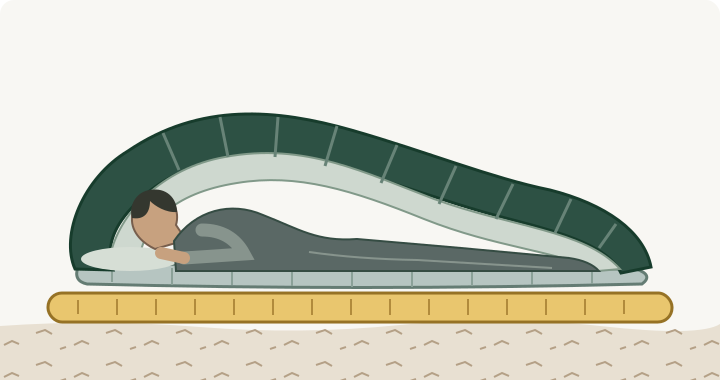
Lofted insulation
traps warm air around you
Compressed insulation
squashed beneath your body, and much less effective there
Sleeping mat
provides essential insulation from the cold ground
Ground
can be surprisingly cold, even in summer
Think system
Sleeping bag + sleeping mat = better warmth and comfort.
Stay comfortable
A well-matched system helps you sleep better, wherever you camp.
Be prepared
Conditions can change. A good sleep setup helps you enjoy the adventure.
Better days outside
A warmer night means more energy for the adventures ahead.
Sleeping bag and mat work together to keep you warm, comfortable and better rested. A well-matched system helps you sleep better wherever you camp, and a warmer night simply means more energy for the day ahead.
4Down or synthetic?
This is often presented as though one type of insulation is simply technologically superior and everyone else is merely waiting for their budget to catch up.
It makes more sense to think in terms of disadvantages instead.
Down is excellent when you want a lot of insulation for relatively little weight and packed volume — which is exactly why it turns up so often in lightweight and premium backpacking bags. Good down equipment, properly cared for, can also have a genuinely long useful life.
Its disadvantages are cost and moisture sensitivity. Modern fabrics and hydrophobic treatments have made down more forgiving than it used to be, but keeping your sleeping insulation dry is still very good practice.
Synthetic insulation is generally bulkier and heavier for comparable warmth, but it’s often cheaper, dries more readily, and is considerably more forgiving when conditions turn damp.
The useful question, then, is:
Which disadvantage would actually bother you?
If your sleeping bag spends most weekends travelling 30 metres from the boot of a car to a tent, paying heavily to remove 400 grams and a few litres of packed volume may achieve remarkably little. If you’re carrying everything for 15 miles over hills, those same savings suddenly become a great deal more interesting.
Neither material wins everywhere.
Down or synthetic? Choose the compromise that suits your trip
Neither wins everywhere. Start with the disadvantage you are least willing to carry.
Down
best when weight and packed size matter. Usually lighter for comparable use, packs smaller, excellent warmth-to-weight potential. Usually costs more and needs sensible moisture management. Strong fit for backpacking and lightweight travel.
Synthetic
best when price and damp tolerance matter more. Often cheaper, more forgiving in damp conditions, a straightforward choice for campsite use. Usually heavier and bulkier for comparable warmth. Strong fit for value, car camping and damp-prone use.
These are category tendencies, not guarantees — compare the actual products once you’ve chosen the insulation type that fits your use. Down and synthetic solve different problems; neither is automatically the better choice.
5What does fill power actually tell you?
Fill power is one of those specifications that sounds wonderfully decisive. Higher must be better, surely?
It tells you something useful — just not quite that.
Fill power describes how efficiently down lofts. Higher-quality down can create more loft for a given weight, which helps manufacturers build lighter, more compressible insulation.
What it does not tell you is how warm a sleeping bag is on its own.
A bag containing a small amount of very high-fill-power down can still be less warm than a heavier bag containing more lower-fill-power down. Construction, fill quantity, shape and how the insulation is distributed all matter just as much.
So use the temperature rating to answer: “Is this warm enough for my intended conditions?”
Then use fill power, weight and packed size to answer: “How efficiently does it achieve that?”
Keeping those two questions separate saves a lot of expensive specification-chasing.
6How much should a sleeping bag weigh?
There isn’t a sensible universal answer.
At home, almost nobody picks up two jumpers and becomes excited because one weighs 73 grams less than the other. Carry your belongings uphill for eight hours and you’ll likely change your mind.
For car camping, weight is usually a low priority — warmth, comfort, price and durability can matter far more. For general backpacking, weight and packed volume become genuine considerations, though they still have to be balanced against warmth, price and comfort. For ultralight or long-distance backpacking, relatively small savings across several pieces of equipment can add up to a noticeably lighter pack — which is where premium down, minimalist construction and quilts start to make real sense.
Weight is a constraint, not a score. A 500g sleeping bag isn’t automatically better than an 850g one. It’s better only if it still does the job you need it to do.
7Shape and fit matter more than specifications suggest
A narrow mummy-shaped bag is thermally efficient because there’s less unused space for your body to warm. It can also feel rather like sleeping inside an insulated toothpaste tube if you naturally sprawl.
Some people barely move at night. Others sleep on their side, bring a knee up, change position constantly, or simply dislike anything restrictive. That matters.
A roomier sleeping bag may weigh slightly more and require more energy to warm, but those disadvantages are irrelevant if the narrower alternative stops you sleeping properly in the first place.
Worth checking:
- Maximum user height
- Shoulder and hip room
- Footbox shape
- Whether different lengths or widths are available
- Whether the zip position works for you
- And, where possible, whether you can actually lie inside one before buying
A sleeping bag’s purpose is to help you sleep. Comfort gets a vote.
8What about quilts?
Backpacking quilts take the sleep-system idea a step further.
The insulation directly underneath you in a conventional sleeping bag is compressed by your body anyway, so a quilt simply removes much of that underside material and relies more deliberately on the sleeping mat beneath you.
The potential advantage is obvious: less material can mean lower weight and packed volume.
The trade-off is that the system can be less forgiving. Mat insulation becomes particularly important, and poor fit or draughts around the edges can undermine the benefit. Some people love the freedom of movement; others would rather zip themselves into a conventional bag and stop thinking about it.
Quilts aren’t only for experts, but they make the most sense once you understand the rest of your sleep system. If that idea appeals, don’t compare a quilt and a sleeping bag by weight alone — compare the complete system you’d actually take.
Shape changes the sleeping experience
Thermal efficiency, freedom of movement and simplicity pull in different directions:
Mummy bag
efficient shape, less spare space to warm
Roomier bag
more movement, may cost some weight and efficiency
Quilt
less underside material, relies more heavily on the mat and fit
Comfort matters. The most thermally efficient shape isn’t automatically the best choice if you can’t actually sleep comfortably in it.
9Sleeping bags and damp British conditions
British camping has a talent for introducing moisture from several directions at once. Condensation forms inside tents. Waterproofs come in wet. Grass soaks your knees while you’re pitching. Socks develop ambitions of becoming small reservoirs.
None of that means down is unsuitable for the UK. It means your sleep insulation deserves more protection than equipment that’s expected to get wet.
For backpacking, a waterproof pack liner or a reliable dry-bag arrangement for your sleeping bag is cheap insurance — don’t rely entirely on a rucksack’s outer rain cover to protect your critical dry insulation. Around camp, manage condensation where you can, avoid climbing into the bag in soaked clothing, and air it out whenever conditions allow.
Your waterproof jacket is expected to encounter rain. Your sleeping bag has a considerably better evening if it doesn’t.
10What should you wear inside a sleeping bag?
The old claim that wearing clothes inside a sleeping bag automatically makes you colder is too simplistic.
Dry insulating clothing can genuinely add warmth. The problems begin when clothing is damp, excessively bulky, restricts your circulation, or causes you to overheat and sweat. Pulling on every item in your rucksack also isn’t a good substitute for bringing an appropriate sleep system in the first place.
A sensible approach is to keep dry sleep clothing available when conditions justify it, and use layers to fine-tune comfort from there.
If you regularly need your insulated jacket, trousers and every spare layer just to make the sleeping bag usable in the conditions you expected, the system probably deserves another look.
11Features worth paying attention to
Once warmth, mat, insulation type, weight and fit are right, the smaller features start to matter. Useful details can include:
- A well-shaped hood
- An insulated draught collar
- An effective zip baffle
- A comfortable footbox
- An easy-to-use zip
- Anti-snag construction
- Internal pockets
- Sensible drawcords you can operate in the dark
These features can improve a good sleeping bag. They rarely rescue the wrong one. Think of them as the final 10% of the decision, not the first 90%.
12A simple buying process
If the specifications are starting to blur together, strip the decision back to this order.
Step 1: Define the job. Where will you camp? Which months? Campsites, backpacking or both? What overnight temperatures are realistically possible? How far will you carry the bag?
Step 2: Choose your warmth requirement. Start with the comfort temperature. Give yourself appropriate margin rather than designing around a perfect forecast. If you know you’re a cold sleeper, account for it.
Step 3: Check the sleeping mat. Make sure the insulation underneath you suits the same conditions. Don’t spend hundreds upgrading a sleeping bag before checking whether the mat is actually the weak link.
Step 4: Choose down or synthetic. If low weight and packed size matter, down becomes attractive. If price, simplicity and damp tolerance matter more than carrying weight, synthetic can make excellent sense.
Step 5: Decide how much weight matters. Car camping? Don’t obsess over grams. Backpacking? Set a sensible weight target. Long-distance or ultralight? Now the expensive weight savings may finally have a job to do.
Step 6: Check fit. Length, shoulder room, sleeping position and general comfort.
Step 7: Compare features and price. Only now worry about the final details.
Suppose you’re buying for UK backpacking from late spring into early autumn, you tend to sleep cold, and you’d like enough margin for chilly nights. Your brief might become:
- Comfort temperature around or somewhat below freezing
- Appropriate insulated sleeping mat
- Manageable backpacking weight
- Hood and useful draught protection
- Fit that works for your sleeping position
- A reliable method of keeping the bag dry
Notice what’s missing? “Three season.” You’ve described the actual job instead.
A simple sleeping bag buying process
Make the expensive decisions last, after you know what the bag actually needs to do.
Define the job
Where, when and how will you camp?
Choose warmth
Start with comfort temperature and sensible margin.
Check the mat
Make sure the insulation underneath suits the same conditions.
Pick insulation
Choose down or synthetic according to your use.
Decide on weight
Car camping and backpacking reward different compromises.
Check fit
Length, width, sleeping position and comfort matter.
Compare features & price
Only now optimise zips, hoods, weight and extras.
If the brief is clear, product specifications become much easier to judge.
13The bottom line
A sleeping bag doesn’t need to be the lightest, warmest or most technically impressive option you can afford.
It needs enough insulation for the conditions you’ll realistically encounter, it needs to work with your sleeping mat, and its compromises need to suit the way you camp.
Start with comfort temperature and sensible margin. Then check the mat. Choose down or synthetic according to the job. Make sure the fit works. Only then start paying extra to save weight, reduce packed volume or gain specialist features.
Sometimes the £400 ultralight sleeping bag really is the right tool. Sometimes you’re carrying it from the car park.
Read next
How to choose a sleeping mat for UK camping
A practical guide to warmth, comfort, construction, fit and reliability, from inexpensive foam mats to compact insulated air mats.
Best Sleeping Bags for UK Camping: 10 Bags and Quilts Worth Considering
Compare ten sleeping bags and quilts, with practical guidance on warmth, weight, packed size and choosing the right option for your camping trips.
Join the conversation
What has worked for you? Share a useful tip, ask a question or tell us about your experience. Keep it friendly and leave out personal contact details.
Comments are reviewed before appearing. Your display name and comment will be public; your email address will not. How we handle your information.