
Cool Box or Camping Fridge? Choose for Your Trip, Not the Gadget
There’s a particular kind of optimism that strikes in the camping aisle. You stand in front of a wall of cool boxes, fridges and cooler-shaped objects of uncertain ancestry, and some small voice says “this one looks like it means business.” Three days later you’re fishing a warm yoghurt out of a box that promised otherwise, wondering where it all went wrong.
It went wrong at the decision stage, not the product stage. The question was never really “which cool box is best” — there isn’t one answer to that, whatever the banner adverts imply. The real question is what your trip actually needs: whether you’ll have power, how long the food has to stay cold, and how hot it’s likely to get while you’re not looking. Get that right first, and the model choice mostly sorts itself out.
What follows is a straightforward look at the three ways camping cold storage actually works, three specific UK-available products as worked examples, and the food safety rules that matter regardless of which box you buy.
In a nutshell
- Passive cool boxes (like the BOXIO COOL) use insulation plus ice or cooling packs — no electricity, no fuss, but a finite cold life that depends on your ice and how often the lid comes open.
- Thermoelectric coolers (like the Mestic MTEC-25) plug into 12V or 230V and cool to a certain number of degrees below whatever the air temperature already is.
- Compressor fridges (like the Mestic MCC-25) let you dial in a specific temperature from a range, in the way your kitchen fridge does. A selectable range is not the same thing as a guarantee that the box will hold that exact figure regardless of load, power supply or how often it’s opened.
- None of these guarantee food safety on their own. That’s down to your thermometer, your clock and the official guidance covered further down.
- Prices and stock below were observed on 2 October 2026 and will move — always check before you buy.
1The three technologies, honestly explained
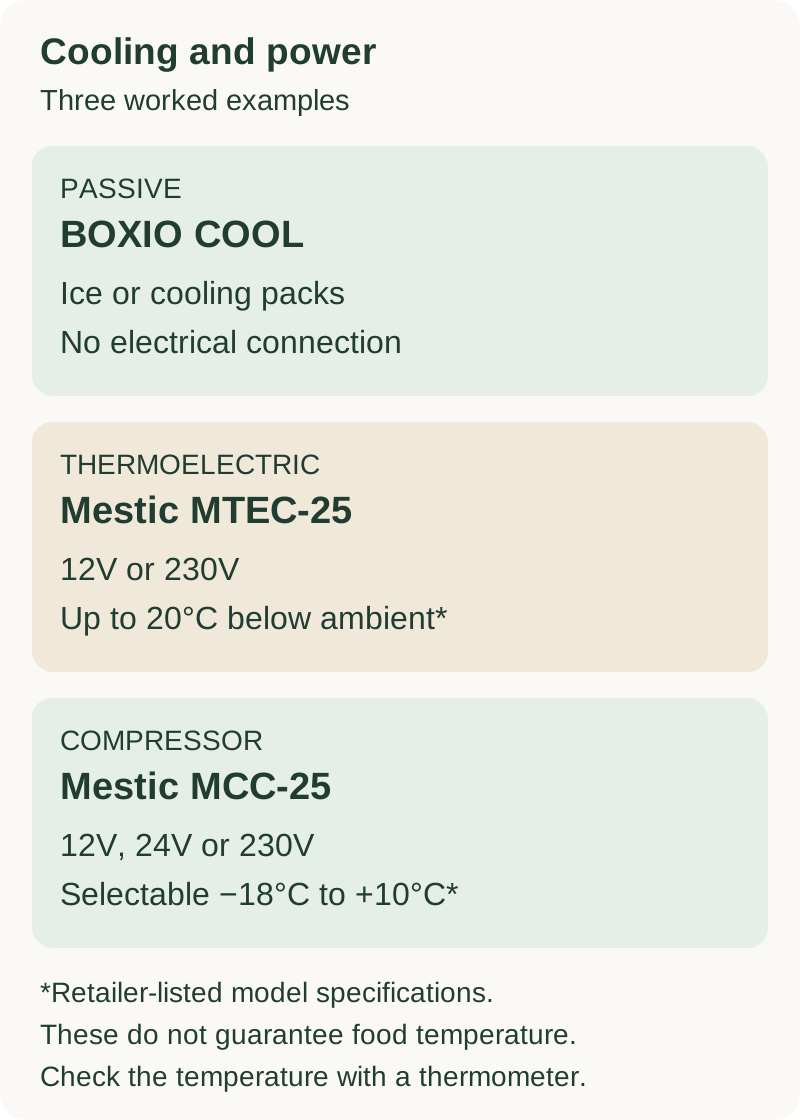
Passive cool boxes are the simplest of the three, and there’s something reassuring about that. No plug, no settings menu, nothing to charge. You freeze some ice packs or fill an ice bag, pack it alongside your food, close the lid, and the insulation does the rest. The BOXIO COOL, for instance, is described by its maker as working completely without electricity — you put in the ice packs or ice, close the lid, and that’s the entire operating procedure. The cold isn’t being generated, only preserved, so how long it lasts depends on your ice, the ambient temperature and how often you’re rifling through the box looking for the cheese.
Thermoelectric coolers use electrical power to move heat from inside the box to outside it. Their cooling capability is commonly expressed relative to the surrounding temperature, rather than as a guaranteed interior temperature. Pre-chill food as required and check the actual temperature with a thermometer. On a warm day, a box can feel cool while still sitting above the 0–5°C range needed for chilled food.
Compressor fridges work differently again: a refrigerant circuit, the same basic principle as your kitchen fridge, that lets you select a specific temperature. The Mestic MCC-25, as an example, lets you dial in anywhere from -18°C to +10°C on its display. That’s a genuinely different proposition to the thermoelectric approach — selectable rather than ambient-relative. It’s worth being precise about what that does and doesn’t mean, though: a selectable range is a feature of the control system, not a guarantee that the box will hold your chosen figure under every load, every ambient condition and every power arrangement. It’s a retailer specification for this exact model, not an independently verified performance claim.
2Matching the method to the trip
Short trips and days out with no guaranteed power suit a passive box well. You’re not relying on anything plugging in, which matters if you’re walking from a car park, at a festival with no hook-up, or simply don’t fancy running a cable across the campsite. The trade-off is that your cold storage has a shelf life governed by how much ice you brought and how disciplined you are about lid-opening — we don’t have independently verified figures for how long any specific box holds temperature, so treat your own thermometer as the final word, not the box of ice packs you bought to go with it.
Driving between stops, or stays with dependable mains or vehicle power, are where a thermoelectric cooler earns its keep. It’s useful for keeping drinks and snacks at a pleasant temperature on the move. Keep an eye on what the ambient temperature is doing to it — on a scorching day it may simply not get cold enough for food that needs proper chilling, and that’s not a fault, it’s physics.
Longer stays, warmer conditions, or anything needing a specific, held temperature point towards a compressor fridge, provided you’ve thought through the power side. Genuinely off-grid use is a calculation involving your battery’s usable capacity, the fridge’s actual consumption and your charging setup — worth doing properly before committing a week’s food shop to it.

3A passive option worth a look: BOXIO COOL
The BOXIO COOL is a straightforward example of the passive category. As of 2 October 2026, BOXIO’s own product system showed the standard variant available to order at £59.90.
What you get: external dimensions of roughly 40 × 30 × 28cm, a weight of 930g, and an approximate internal capacity of 16 litres, made from expanded polypropylene. Worth flagging clearly: the box itself does not come with any cooling packs included. You’ll need to buy ice packs, or use your own ice, separately to get any cooling benefit at all.
This is best thought of as an option for short trips, day use or situations where you simply don’t want anything plugged in. If you need to know exactly how long it holds temperature in your conditions, that’s something to verify with a thermometer rather than take on trust.
4A thermoelectric option worth a look: Mestic MTEC-25
The Mestic MTEC-25 is a thermoelectric example to assess for trips with suitable power available. Check its current specifications, price and connections against your intended use rather than relying on a stock count or an old listing.
A quick note on naming: despite the model number and some marketing copy elsewhere describing it as holding 25 litres, the retailer’s own detailed specification for this exact listing gives a capacity of 23 litres. Worth checking the small print rather than assuming the name tells the whole story. It weighs 4kg, runs on both 12V and 230V including a car plug for drive-time use, and has an eco mode aimed at reducing power consumption.
Its quoted cooling capability should not be treated as an independent measurement or a promise to hold a fixed temperature in all conditions. Check food temperature in use, and confirm the exact electrical requirements before connecting it to your setup.
5A compressor option worth a look: Mestic MCC-25
For longer stays or warmer conditions where you want a specific, selectable temperature, the Mestic MCC-25 compressor cool box is an example, also sold via My Mestic. On 2 October 2026, seven units were shown in stock at £227.99.
Specifics: 25 litres of capacity, suitable for 1-litre bottles, a weight of 12.8kg, and a digital display letting you set anywhere from -18°C to +10°C. It runs on 12V, 24V or 230V, with the 230V adapter included rather than sold separately.
The adjustable range is the headline feature here, and it’s worth being exact about what it means. Being able to select a temperature is not the same as a guarantee that the box will hold it under every load, ambient condition or power arrangement — that’s a retailer specification for this exact listing, not an independent performance test. That makes it a reasonable consideration for a week-long trip or a hot-weather stay, provided your power supply is sorted.
6Specifications
| Specification | BOXIO COOL | Mestic MTEC-25 | Mestic MCC-25 |
|---|---|---|---|
| Type | Passive | Thermoelectric | Compressor |
| Capacity | ~16L | 23L | 25L |
| Weight | 930g | 4kg | 12.8kg |
| External dimensions | 40 × 30 × 28cm | Check before buying | Check before buying |
| Power | None (ice/packs) | 12V and 230V, car plug included | 12V, 24V and 230V, 230V adapter included |
| Temperature behaviour | Dependent on ice/packs and ambient | Up to 20°C below ambient (retailer claim) | Selectable -18°C to +10°C (retailer claim) |
| Cooling packs included | No | N/A | N/A |
| Price at 2 Oct 2026 | £59.90 | £72.99 | £227.99 |
| Stock at 2 Oct 2026 | Available | 341 in stock | 7 in stock |
Check packed dimensions before buying. For the powered models, also check measured power draw/wattage, fuse requirements and ventilation clearances.
7Food safety
This is the part no product can do for you, however confident the box looks.
Official UK guidance (covering England, Northern Ireland and Wales) sets out a few things that matter regardless of what you’ve packed your food in:
- Chilled food should be kept between 0°C and 5°C. A fridge thermometer is the recommended way to check this — don’t take a dial setting or a product’s advertised range as proof of the actual temperature inside.
- Keep chilled food out of proper refrigeration for the shortest time possible — a general maximum of four hours during preparation. This is a preparation-time limit, not a blanket allowance for how long a packed lunch or picnic can safely sit in a cool box for the day.
- In hotter-than-usual weather, that drops to two hours. Official heatwave guidance specifically says not to leave food out longer than two hours in hot conditions, and to throw away any barbecue or picnic perishables that have exceeded two hours outside the fridge during hotter-than-usual weather.
- If you’re not sure how long something’s been out, the official advice is to take the cautious route and not eat it. Uncertainty isn’t a reason to assume it’s probably fine.
- Use shade and frozen ice packs. Keep picnic food in a closed cool bag or box, out of direct sunlight, and open the lid as little as possible.
- Keep raw and cooked food separate. Raw meat, poultry and fish should be sealed and kept below other food so they can’t drip onto it; cooked meat should be stored away from raw.
Nothing in their specifications substitutes for actually measuring what’s inside. A selectable compressor range or an ambient-relative thermoelectric figure tells you what the control system is capable of attempting, not what temperature your lunch is actually sitting at on a warm Tuesday. Carry a thermometer, check it, and follow the time limits above rather than the box’s marketing copy.
8Decision
A short way to work through it:
- Do you have reliable power? No power, or you don’t want to rely on it: passive box. Driving with occasional hook-up: thermoelectric. Dependable 12V/230V or a properly planned off-grid setup: compressor.
- How hot is it likely to get, and what are you storing? Drinks and snacks in mild weather tolerate an ambient-relative thermoelectric cooler reasonably well. Anything that needs a specific held temperature — particularly in warm weather — points towards a compressor fridge with a selectable range, measured and verified rather than assumed.
- How long is the trip, and how much can you carry? A 12.8kg compressor fridge is a different proposition for packing and lifting, and worth weighing against your actual trip length.
- Whatever you choose, check it with a thermometer. A selectable range or an ambient-relative claim is not proof that your food is sitting at a safe temperature. That’s down to you, your thermometer and the official time limits above.
The BOXIO COOL, Mestic MTEC-25 and Mestic MCC-25 are given here as dated, exact-model examples only — observed as orderable in the UK on 2 October 2026 at the prices and stock levels listed above. None of that is a promise that stock or pricing will still be the same when you come to buy, so it’s worth a quick check before you commit the credit card to a yoghurt’s safe passage through a British summer.
Read next
How to Choose a Sleeping Bag for UK Camping
Choose a sleeping bag suited to UK conditions, with clear advice on temperature ratings, insulation, fit and getting a comfortable night outdoors.
How to choose a sleeping mat for UK camping
A practical guide to warmth, comfort, construction, fit and reliability, from inexpensive foam mats to compact insulated air mats.
Join the conversation
What has worked for you? Share a useful tip, ask a question or tell us about your experience. Keep it friendly and leave out personal contact details.
Comments are reviewed before appearing. Your display name and comment will be public; your email address will not. How we handle your information.